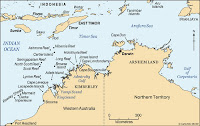
 From at least the 1720s (Mitchell 1994: 56) until the early 1900s fleets of perahu sailed from Makassar (South Sulawesi) to the northern Australian coast each year to collect trepang or bêche-de-mer — a genus of edible holothurians found in abundance on the seabed in shallow tropical waters. Processed trepang has long been a commodity in great demand in Chinese markets, where it is considered as a culinary delicacy with potent medicinal properties. The trade soon extended to other marine commodities, including turtle shell and shark fin. This trade began well before European colonisation of the Australian continent, and involved significant contact with Australian Aborigines. The trade operated through the city of Makassar and the majority of people involved in the industry were Makassarese. As a result the term ‘Macassan’ is applied to the industry in the literature, but it is thought that the fishing crews included Bugis and Bajo (Macknight 1976: 18).
 The Macassan fleets fished three areas: the Northern Territory coast from Cape Don to the Gulf of Carpentaria; parts of the Kimberley coast of Western Australia from Cape Londonderry to Cape Leveque and perhaps further south towards Port Hedland; and the offshore reefs and islands in the Timor Sea (Crawford 1969: 89; Macknight 1976: 2, 27). Evidence of Macassan fishing activity is documented in Dutch archival records, in recorded contact with other Europeans, and also from the results of archaeological investigations (Crawford 1969; Fox 1977a; Macknight 1976; Bottrill 1993; Campbell and Wilson 1993; Mitchell 1994). In addition to the activity of the Macassan fleets, historical sources also document fishing activity by Bajo perahu travelling independently or accompanying Macassan perahu to Arnhem Land and the Kimberley coast in the 1840s (Macknight 1976: 18, Mitchell 1994: 32).
Ashmore Reef, located 840 km west of Darwin and just 90 km south of Roti, has been regularly visited and fished by Indonesians since the eighteenth century. The area has its own Indonesian name — Pulau Pasir (Sand Island). A Rotinese narrative details the accidental discovery of Sand Island in the 1720s, and Dutch historical sources ‘confirm that Ashmore was known to Indonesian fishermen in the first half of the eighteenth century’ (Fox 1998: 118–9). During a visit to Kupang in 1803, Flinders obtained information linking Macassan trepang fishing activity to ‘a dry shoal lying to the south of Rottee [Rote]’ (probably Ashmore Reef) and met a number of Macassans on the coast of northern Australia in the same year (Flinders 1814: 257). Since Ashmore Reef has a supply of fresh water and a sheltered lagoon, it has long been an important ‘staging post’ for Indonesian perahu on their voyages further south to other islands and reefs (Fox 1998: 117).
Macassan voyages to northern Australia began to decline in the latter part of the nineteenth century and came to an end in 1907. In 1882, licensing and customs duties were imposed on Macassan trepangers in the Northern Territory, and licences were not issued to the Macassans after 1906 (Macknight 1976: 106, 125). The Macassans were never licensed to fish in northwestern waters (Campbell and Wilson 1993: 31) so it is not clear why they also ceased to visit the Kimberley region (Crawford 1969: 114). All foreign fishing in territorial waters was illegal under Western Australian legislation from the 1870s, but these laws were never enforced because ‘the Kimberley coast remained virtually beyond the limits of government control’ (ibid.: 116–7). Although the reasons are unclear, Macknight (1976: 118) believes that those Macassans who ceased to visit Australia switched to other maritime activities within the Indonesian Archipelago.
When the Macassan fleets ceased operations in the Northern Territory and Kimberley region, fishing activity along the northwest coast of Australia and on offshore reefs was maintained by fishermen in smaller perahu originating from regions other than Makassar. Very little is known about these voyages and few records remain, but the visits are thought to have been widespread (Crawford 1969: 115, 124).
Between the early 1900s and 1924, historical sources report fleets or solitary perahu originating from a number of different islands across the Indonesian Archipelago. For example, vessels from Kupang sailed to Roti to take on supplies, then sailed south to Ashmore Reef and from there to other offshore reefs and islands. Vessels also sailed along the Kimberley coast, working nearby areas such as Long and Holothuria reefs, and often landed on the mainland to collect supplies of wood and water and process their catch before returning to Kupang to sell it (Crawford 1969: 124–5; Campbell and Wilson 1993: 18).
The initial decline of Macassan voyaging to Arnhem Land and the Kimberley coast in the 1870s coincided with the growth of the pearl shell industry in the Pilbara and later the Kimberley region from the 1860s, when European settlers began appropriating land under pastoral leases (Campbell and Wilson 1993: 16–18). Initially, pearl shells were mainly gathered from exposed reefs during low tide, but by the 1870s Aborigines were employed as divers and ‘Malay‘ men from Indonesia, Singapore and the Philippines were indentured to European captains to work as seamen and divers on pearling luggers (McGann 1988: 2; Bottrill 1993: i; Campbell and Wilson 1993: 16). The first Indonesians to work in the pearling industry were recruited directly from coastal villages on the islands of Alor and Solor in 1870 (McGann 1988: 21–2). In 1874, 316 divers were recruited from Timor, and in 1875 it was reported that as many as 1000 ‘Malays‘ from Makassar, Solor, Ende, and Singapore (along with 200–300 Aborigines) would be working during the next pearling season in northwestern Australia (Bottrill 1993: 15–16). Sama-speaking Bajau from the Philippines were added to the labour force with the further expansion of the industry (McGann 1988: 42, 45).
When the underwater diving suit began to be used in 1886, Aborigines and Malays ‘were considered unsuited to work with mechanical apparatus’ (Campbell and Wilson 1993: 17). Coupled with later legislative changes regulating the use of Indigenous and indentured labour, this eventually led to a decline in the number of Malays and Aborigines engaged in the pearl shell industry. They were mostly replaced by Japanese workers who came to dominate the now Broome-based industry from the late 1880s until its decline after 1935 (ibid.). However, some men were still drawn from Kupang and surrounding islands to work in the pearling industry until the 1960s (Anderson 1978).
In the 1880s, the first European pearlers left Cossack for Kupang. As well as recruiting Malay labour for the northwest pearling industry, they went into partnership with Dutch, Arab or Chinese merchants and fished the northwest for pearl shell in vessels flying the Dutch flag. From Kupang, pearlers could fish waters outside of Australia’s 3 nautical mile territorial waters without a licence, and there was no law preventing them from obtaining shelter and supplies along the Australian coast if needed (Bach 1955: 208). These men were joined shortly after by other pearlers from Port Darwin and Broome (Bain 1982: 187). The first pair of entrepreneurial pearling captains to skipper vessels operating out of Kupang in the 1880s were Hart and Geach Drysdale. Their place was taken by Henry Francis Hilliard who came to dominate the Kupang-based fishing activities in the Timor Sea in the 1890s. He in turn was followed by his son Robin Hilliard, W.S. Smith and Alex Chamberlain (Crawford 1969: 115; Bain 1982: 187).
Kredit kepada: http://epress.anu.edu.au/


